
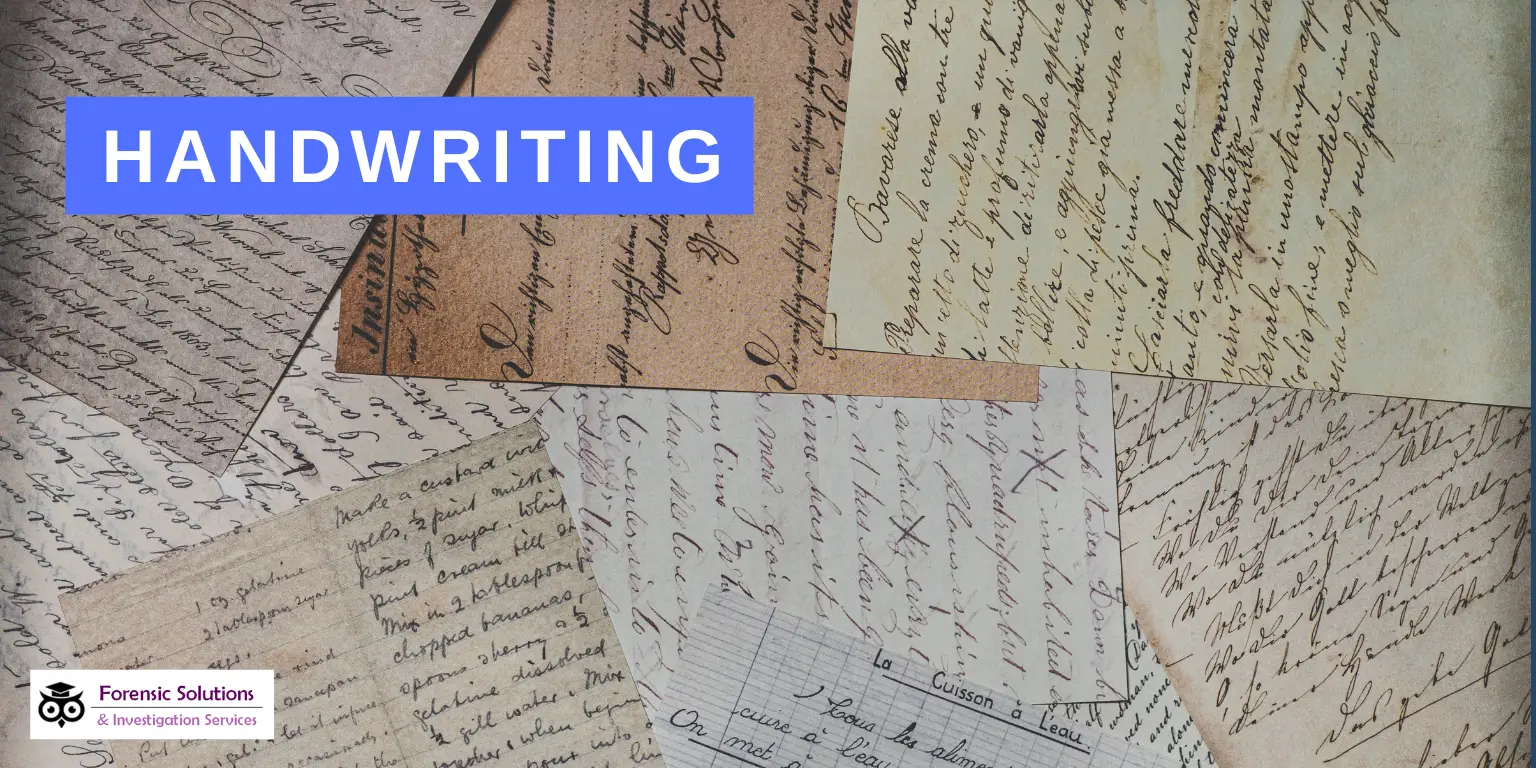
Handwriting Examination
Handwriting is more than just words on paper — it is a personal form of expression that carries subtle and unique characteristics formed through years of habit. From the way a person shapes letters to the rhythm of their writing, every individual develops a distinct handwriting pattern, much like a fingerprint. In forensic science, these unique characteristics become powerful tools in identifying, authenticating, and verifying the author of a written document.
At Forensic Solutions, we specialize in scientific handwriting examination to assist in both civil and criminal investigations. Our role is to determine whether two or more pieces of handwriting — such as in contracts, wills, agreements, cheques, or anonymous letters — were written by the same person. Each conclusion we draw is based on established forensic principles, not opinions or assumptions.
The Science Behind Handwriting Examination
Handwriting examination is a branch of Questioned Document Analysis (QDE). It involves the systematic comparison of questioned writings with known (standard) samples. The process requires careful observation, advanced imaging tools, and a deep understanding of how handwriting develops and varies under different conditions.
Every individual’s handwriting reflects a combination of neuromuscular coordination, speed, pressure, letter formation, rhythm, and spacing. These characteristics are as unique as a person’s gait or voice. A forensic handwriting expert studies these features to identify:
Natural handwriting characteristics – elements consistently repeated by a writer without conscious effort.
Individualizing features – specific letter shapes, connections, or proportions that make one’s handwriting unique.
Abnormalities or signs of forgery – hesitation marks, patching, tremors, unnatural pen lifts, and inconsistent slant.
Common Cases Requiring Handwriting Examination
Handwriting verification plays a critical role in a wide variety of disputes and investigations, such as:
Will and property disputes – verifying the authenticity of a testator’s handwriting or signature.
Financial frauds and forged cheques – identifying whether handwriting on a cheque, receipt, or form was genuine or falsified.
Anonymous or threatening letters – tracing the potential author through writing patterns.
Employment and academic frauds – confirming the authorship of written statements or documents.
Insurance and legal claims – detecting forged or altered documents submitted as evidence.
Our experts provide clear, scientifically validated reports that are legally admissible and presented in a manner understandable to clients, lawyers, and courts alike.
Our Process at Forensic Solutions
We follow a structured and transparent methodology to ensure accuracy and objectivity in every case:
Collection of questioned and standard documents
We obtain the disputed handwriting and comparable samples written under natural conditions.Scientific examination under magnification
Using optical and digital microscopes, we analyze fine details such as stroke patterns, pressure distribution, and pen movement.Side-by-side comparison and analysis
We compare individual letters, word spacing, alignment, and rhythm to identify similarities and differences.Detection of forgery methods
We identify whether the writing was forged by imitation, tracing, patching, or simulation.Preparation of a clear, concise expert report
Each report is supported by scientific reasoning, high-resolution photographs, and exhibits suitable for legal submission.Expert testimony, if required
Our experts are qualified to present findings before the court and assist in explaining the technical aspects of the analysis.
Scientific Tools and Techniques We Use
At Forensic Solutions, our handwriting examination process combines traditional expertise with modern technology. Depending on the case requirements, we employ tools such as:
Stereomicroscope and video spectral comparator (VSC) for analyzing ink, pressure, and sequence of strokes.
Image enhancement and overlay analysis for comparing handwriting at microscopic precision.
Digital documentation and secure record management for maintaining chain-of-custody and confidentiality.
These techniques help ensure our opinions are based on verifiable, repeatable scientific evidence.
What Makes Our Handwriting Examination Reliable
Scientific foundation: Our examinations are conducted according to recognized forensic document examination protocols.
Court-accepted reports: Our findings are drafted in compliance with legal requirements, ready for submission in civil or criminal matters.
Timely service: We value our clients’ need for clarity and justice, delivering results efficiently without compromising accuracy.
Transparent communication: We explain our conclusions clearly, avoiding technical jargon so that even non-specialists can understand the findings.
Our goal is not only to analyze documents but to help clients uncover the truth behind the handwriting in question.
Handwriting Examination vs. Graphology
It is important to clarify the distinction between handwriting examination and graphology, as these terms are often confused.
Handwriting Examination is a forensic science discipline focused on identifying or eliminating a writer through the study of physical characteristics in handwriting. It is used for legal and investigative purposes and involves scientific tools, comparison techniques, and measurable parameters. The conclusions are based on physical evidence and scientific reasoning.
Graphology, on the other hand, is the psychological interpretation of handwriting to understand personality traits, behavior, or emotional states. It does not deal with authorship or authentication but with human psychology.
At Forensic Solutions, we offer both services — but each is handled by specialized experts with distinct objectives.
If you want to determine who wrote a document, handwriting examination is the service you need.
If you wish to understand the personality behind the handwriting, then graphology is the right approach.
Conclusion
Handwriting examination is a fascinating and vital component of modern forensic investigation. It bridges the gap between science and law, transforming simple pen strokes into evidence that can influence justice. At Forensic Solutions, we combine our scientific expertise, legal understanding, and commitment to truth to deliver dependable results in every case.
Whether you are a legal professional, investigator, or individual seeking clarity in a disputed document, our team ensures your case receives the attention, precision, and integrity it deserves.
Because at Forensic Solutions, we believe — Justice delayed is justice denied.